

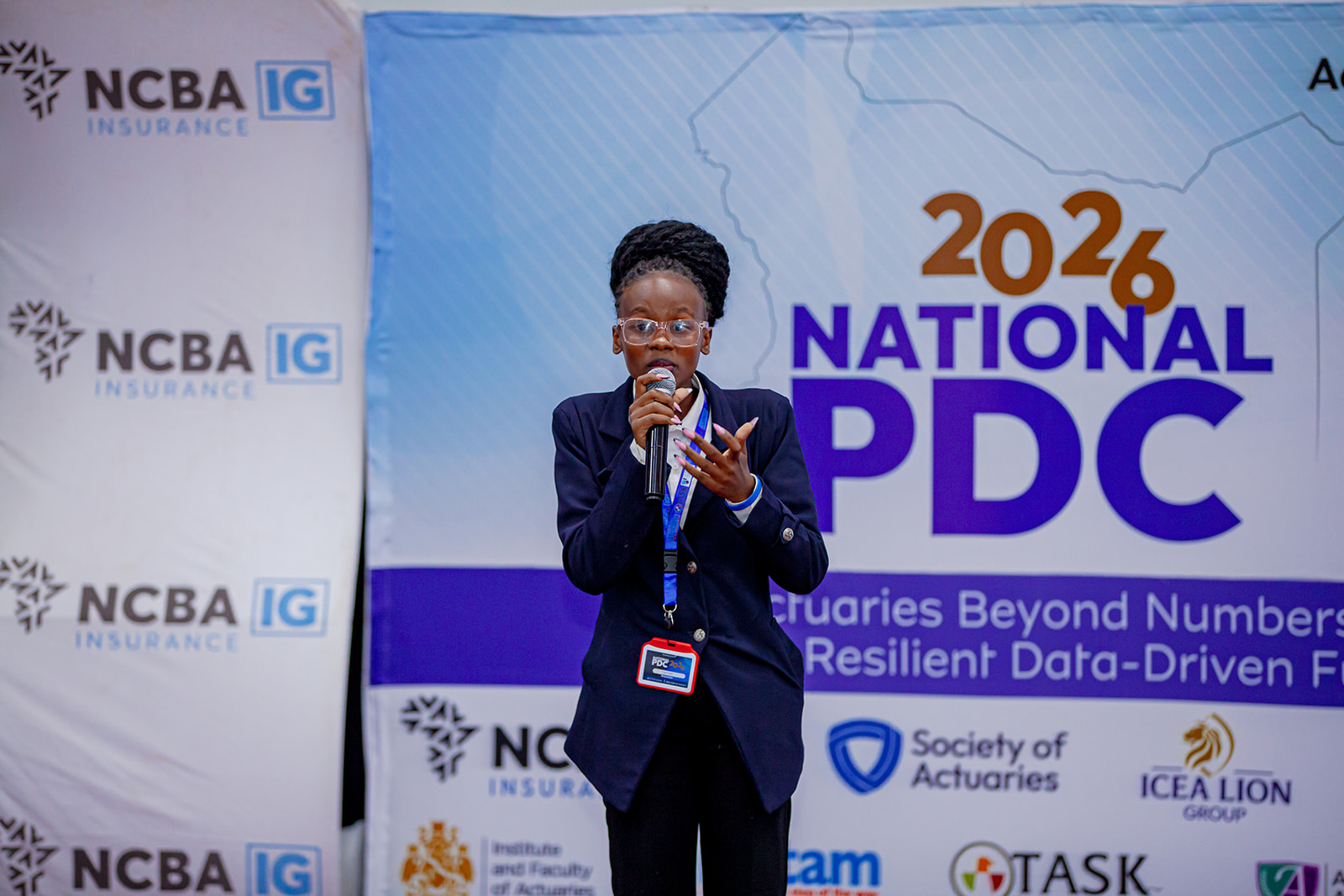
How much can a small error in risk prediction cost an insurance company? Lucy Njoki, a student at Kirinyaga University, explores this question in her research, Impact of Inaccurate Risk Prediction on Premium Pricing and Insurer Profitability, presented at the 2026 Product Development Competition held at Daystar University.
The study examines how underestimating or overestimating insurance claim frequency and severity affects premium adequacy, loss ratios and underwriting profitability. Using secondary property and casualty claims data from a 1,000-policyholder portfolio, the research applies Poisson and lognormal distributions to model claim frequency and severity, respectively. Its findings show that underestimating risk can lead to insufficient premiums, increased claims pressure and potential financial instability, while overestimating risk can make premiums less competitive and drive away lower-risk customers.
To address this challenge, Lucy proposes an IFRS 17-aligned uncertainty-based premium pricing framework that incorporates a stochastic Risk Adjustment into the premium-setting process. Rather than relying solely on a single expected-loss estimate, the model accounts for the uncertainty surrounding that estimate. Greater uncertainty in the underlying claims data results in a higher risk margin, while more stable and credible data allows for more competitive pricing. This approach aims to balance financial protection for insurers with fairness and affordability for policyholders.
The solution’s distinguishing feature is its recognition that prediction errors cannot always be eliminated. Instead of focusing exclusively on improving the accuracy of risk estimates, it seeks to ensure that uncertainty is reflected in the price itself. The framework could support actuaries in developing more resilient pricing models, help insurers strengthen underwriting performance, and provide regulators and researchers with insights into the relationship between model uncertainty and financial sustainability.
Currently at the Minimum Viable Product (MVP) stage, the research presents an opportunity for further testing, actuarial validation and industry collaboration to assess its practical application in insurance pricing. Its development reflects the growing importance of combining robust risk modelling with financial reporting principles to address real-world challenges in the insurance sector.
Through the Actuarial Students Society of Kenya (ASSK) and its Product Development Competition, emerging actuarial professionals are encouraged to transform technical knowledge into solutions that strengthen the insurance industry and promote sustainable financial decision-making.
Meet the Researcher
Lucy Njoki — Kirinyaga University
Email: njoki2110@gmail.com
LinkedIn: Lucy Njoki
Interested in collaboration or partnership? Contact ASSK to explore opportunities to support the validation and development of innovative actuarial research.
This product was presented in this year’s (2026) National PDC held at Daystar University